How Does Theatre Help Students Overcome Stage Fear and Nervousness?

Stage fear is a common issue that students have to face. Standing in front of a crowd and speaking loudly or performing on stage can be scary. Some students feel nervous, forget what they want to say, or avoid going on stage completely. Theatre can help students overcome this fear in a comfortable and encouraging way.
Theatre is not only about performing in a play. It’s a learning process in which students develop confidence, the ability to communicate, and become comfortable in front of others. Let’s discuss how to overcome stage fear in a detailed manner.
Why Do Students Feel Stage Fear?
Before understanding how the theatre can aid in the classroom, it is important to understand why students are scared:
• Fear of making mistakes
• Worry about being judged
• Lack of practice speaking in public
• Low self-confidence
• Overthinking about what others will think
Theatre activities directly impact these areas and help students relax.
How to Overcome Stage Fear
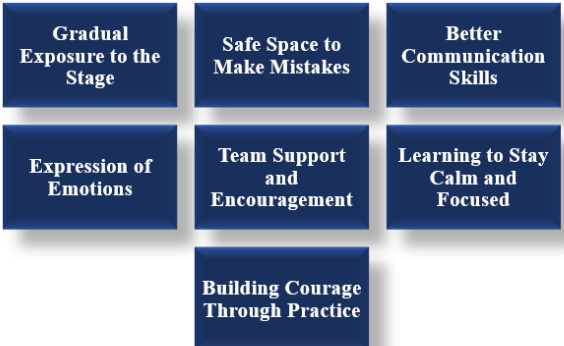
1. Gradual Exposure to the Stage
Students usually don’t start with very big performances. They start with easy ones such as:
• Reading lines in small groups
• Voice warm-ups
• Short role plays
• Fun drama games
The steps-by-step method helps make the stage feel familiar instead of scary.
2. Safe Space to Make Mistakes
In theatre, mistakes are considered to be an aspect of learning. Students understand that forgetting a line or being nervous is a normal reaction. This relieves stress and allows students to try it again without any stress.
3. Better Communication Skills
Theatre classes teach students how to:
• Be clear in your speech
• Use proper voice tone
• Maintain eye contact
• Be attentive
When students feel prepared to communicate, their nervousness naturally decreases.
4. Expression of Emotions
A lot of students feel nervous because they are unable to express their thoughts publicly. Theatre encourages them to share their emotions through:
• Dialogue
• Movement
• Expressions on the face
This emotional release helps them feel relaxed and confident.
5. Team Support and Encouragement
Theatre is a group activity. Students perform together, help each other, and then celebrate the progress they make. Being in a community that supports them will make them feel comfortable and less anxious.
6. Learning to Stay Calm and Focused
Rehearsals train students to be focused in the present moment. They learn to concentrate on their job instead of focusing on the audience only. This skill helps in reducing overthinking.
7. Building Courage Through Practice
Repeated practice makes students feel more comfortable in performing. Each successful experience builds confidence and lessens fears little by little.
Benefits of Theatre Beyond the Stage
Students who participate in theatre often notice improvements in daily life:
• Confidence in classroom presentations
• Participation in discussions is more active
• Improved social skills
• Stronger self-belief
• Ability to handle pressure calmly
These skills help students in growing not only as performers, but also as individuals.
Theatre Programs at Ramagya Arts Academy
Ramagya Arts Academy offers structured theatre programs that allow students to improve their creativity and develop personally.
DRAMA – Trinity Theatre Program
For students who are 10 years old or above, this course is affiliated with Trinity College London and provides structured training in acting, speech and drama. Students explore poetry, prose and drama while learning performance skills on stage and performance.
Key learning outcomes include:
• Developing vocal and physical expression
• Building expressive reading skills
• Reflecting on performances for improvement
• Creatively interpreting dramatic texts
• Making confident performance choices
DRAMA – Non-Trinity Theatre Program
Designed for students aged 8 to 16, this program focuses on acting and personality development in group settings. Through interactive classes students can explore the art of improvisation, drama, and expression without the pressure of exams. This is a great option for those who are looking to develop the foundational skills of theatre in a comfortable setting.
Key learning outcomes include:
• Gaining confidence in public speaking and presentations
• Exploring role-play and improvisation techniques
• Improve teamwork and think creatively
• Understanding the role of character and development of the scene
• Guidance by an Experienced Facilitator
Both programs are guided by Mr. Debraj Dutta, a postgraduate in Design and Direction from Rabindra Bharati University, Kolkata. With expertise in children’s theatre and drama in education, and experience as a senior resource person with NSD’s Theatre in Education Company, he brings strong knowledge and practical insight to students’ learning journey.
Through these programs, students are given an opportunity to learn about the theatre, gain confidence and conquer stage phobia step-by-step.
FAQs
1. Can theatre help students who are afraid of public speaking?
Yes, theatre is the perfect environment for practicing public speaking. It also gradually reduces fears. A regular exposure to performances makes students feel more at ease over time.
2. Is theatre only for students who want to become actors?
No, theatre helps build confidence and communication skills useful in any field. It supports overall personality development beyond performance.
3. What age is suitable to start theatre training?
Children can start from a young age, especially when programs are designed for different age groups. Early exposure helps build confidence naturally.
4. Does theatre improve personality development?
Yes, it helps students become more confident, expressive, and socially comfortable. They learn to present themselves with clarity and self-belief.